The essentials
- The Santa Maria Caves are a group of five sea caves cut into the rock of Comino, one of the Maltese islands in the Mediterranean Sea.[1]
- Ferries run from Mġarr on Gozo and Ċirkewwa on Malta to the Blue Lagoon, and the crossing takes approximately 15 minutes each way.[2]
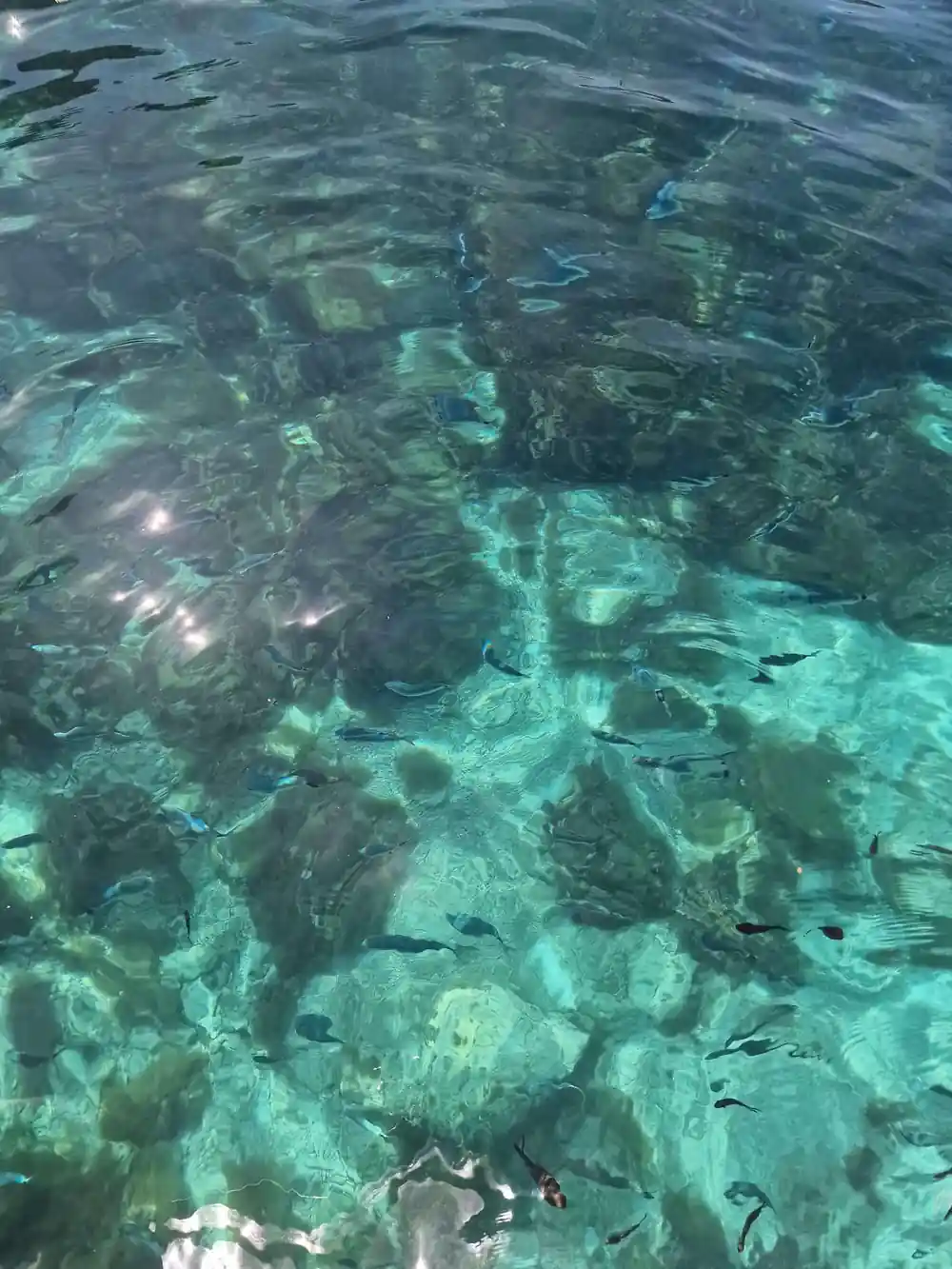
- The turquoise that gives the Blue Lagoon its name comes from light reflecting back up through shallow, clear water from the white sand below.[3]
- The private boat tour to the Blue Lagoon, Comino, Gozo and the sea caves, with swim stops, is rated 4.98 from 117 reviews.[4]
- Reserve now and pay later, with free cancellation up to 24 hours in advance for a full refund on the private tour.[4]
- Top choice Private boat, swim stops from US$195 Duration2 - 4 hours[4]Rating4.98 from 117 reviews[4]GuideLive tour guide: English[4]CancellationFree, up to 24 hours ahead[4] Check availability
- Gozo and Comino tour from US$35 Duration7 hours[5]Rating4.45 from 20,111 reviews[5]GuideAudio guide included[5]CancellationFree, up to 24 hours ahead[5] See this tour
- Catamaran to the bays from US$63 Duration5 - 6 hours[6]Rating4.68 from 6,838 reviews[6]GuideHost or greeter: English[6]CancellationFree, up to 24 hours ahead[6] See this tour
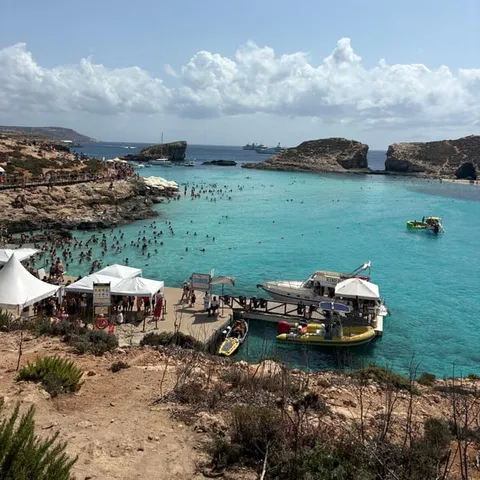
The Santa Maria Caves consist of five caves located on the island of Comino, one of the Maltese islands in the Mediterranean Sea.
Is the private boat tour worth it?
Trip prep
- Book a boat with a swim stop at the sea caves, not just a Blue Lagoon drop-off.
- Check the meeting point and the starting time when you book; departures vary through the day.
- Pack high-factor sun cream, a hat and a light long-sleeved top for the ride back.
- Carry a little cash for the kiosks and small operators around the lagoon.
On the water
- Hold on near the cave mouths; the swell moves through even on calm days.
- Keep clear of roped-off water where other boats are manoeuvring.
- The sea is noticeably warmer in late summer than in spring.
- Ask about step-free boarding; the private boat is wheelchair accessible.[4]
Why an island this small has so many sea caves
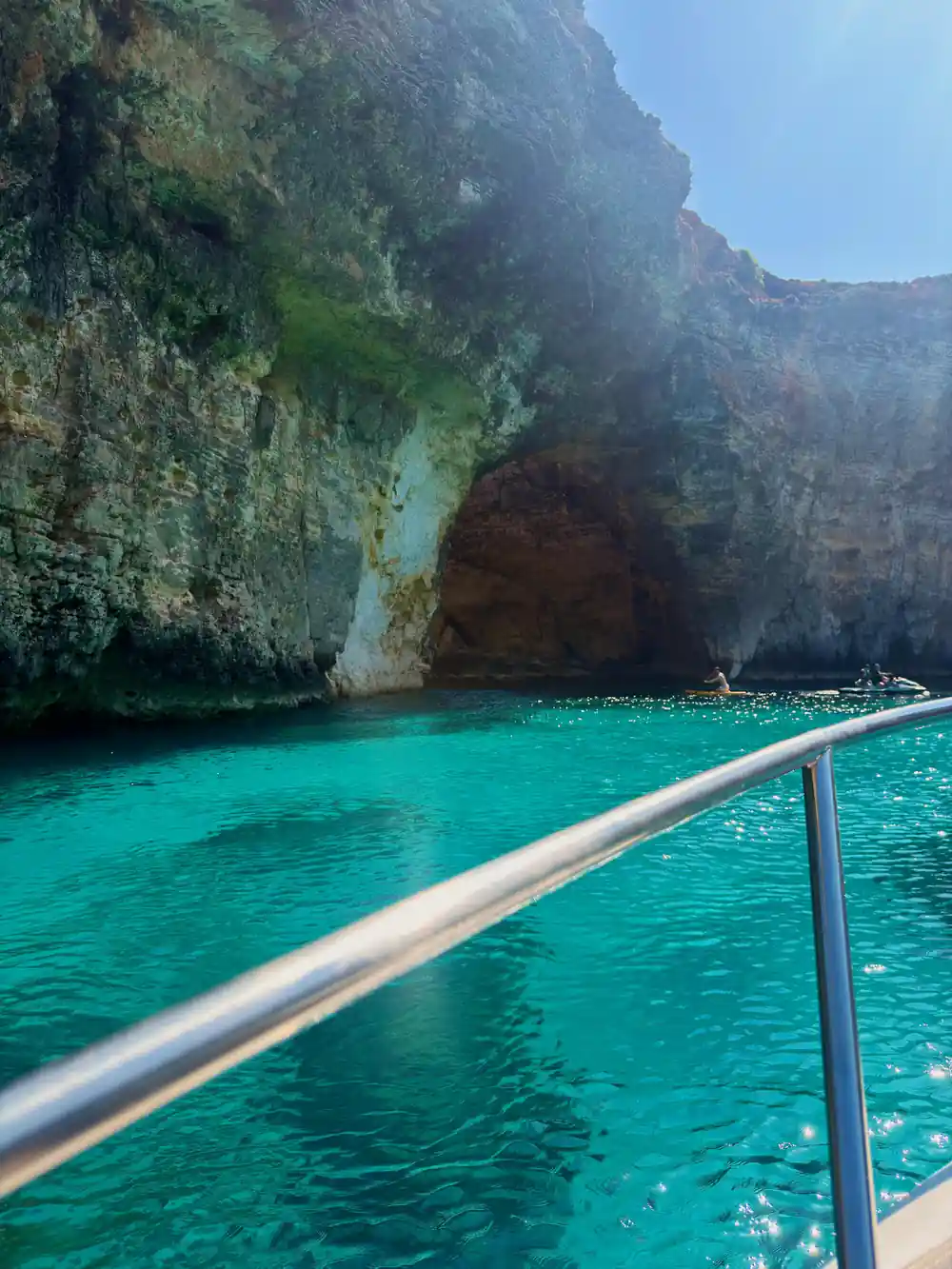
Comino sits between Malta and Gozo, a low, pale island of limestone that the sea has been undercutting for thousands of years. Waves find the weak joints in the rock, widen them, and hollow out the softer bands behind, which leaves a coastline of arches, inlets, shallow shelves and dark mouths rather than one plain wall. The group most boat trips head for is the Santa Maria Caves, which consist of five caves on the island.[1] Comino has an official population of 4, so almost everything along these cliffs is left to the birds and the weather.[7]
The island is a bird sanctuary and nature reserve, and the water around it is a Natura 2000 marine protected area, so the cliffs and the caves below them are not built on or lit up.[8] Birds still nest on the rock: the Yelkouan shearwater breeds on Kemmuna, with an estimated 150-220 pairs nesting there.[9] A boat is the practical way to see the caves, and the cliffs show a different face at every angle as you move along them, which is a large part of the appeal of a slow loop around the island.
What the Comino caves are like inside
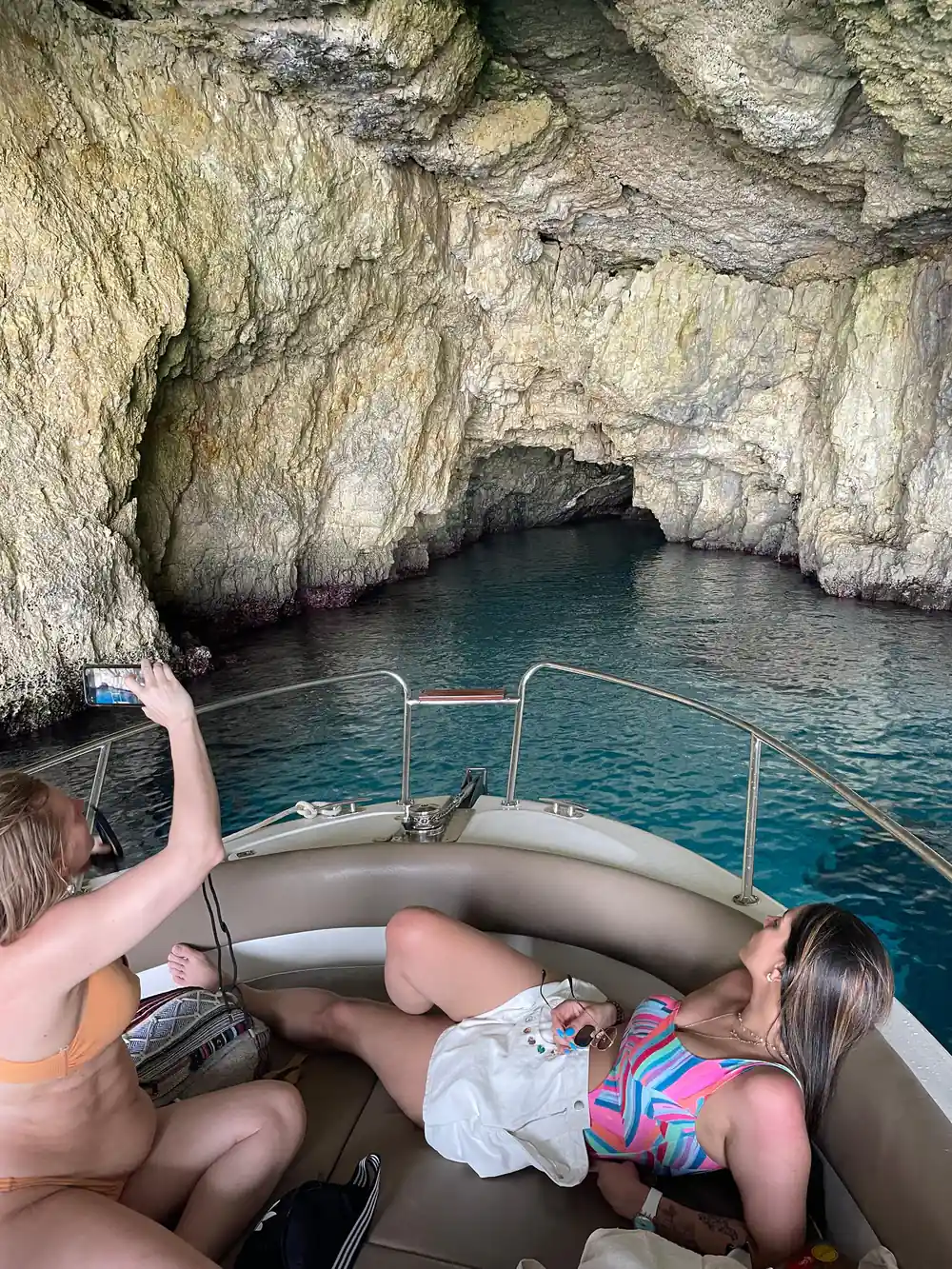
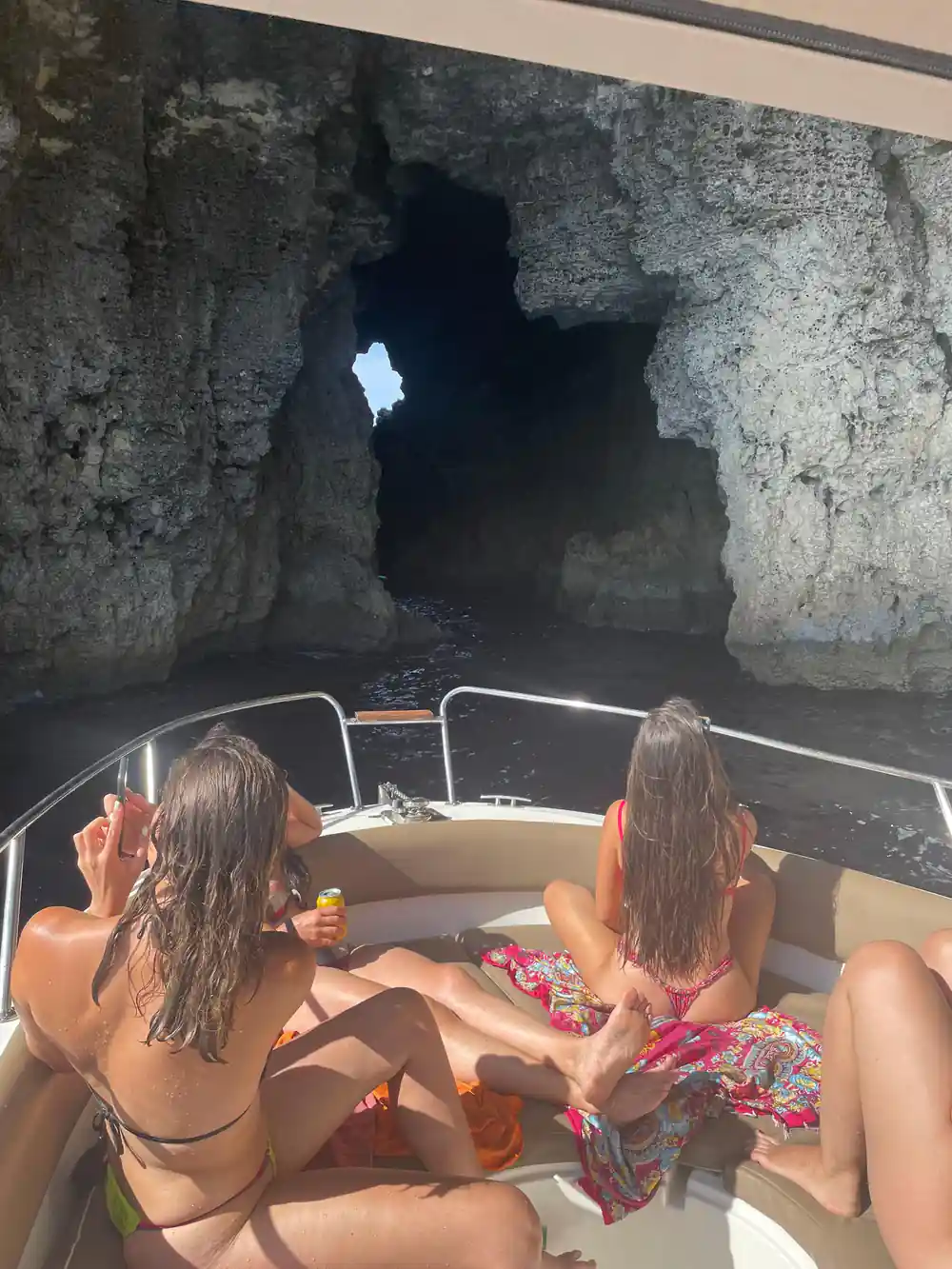
Inside, the caves are cool and dim after the glare of the open sea. The walls are worn smooth and streaked with grey and ochre, and the water keeps a steady, oily swell even when the surface outside looks calm. Sound behaves oddly: your voice comes back off the roof, and the slap of water on rock carries much further than you expect. Some caves are shallow enough to show the bottom, while others drop away into darkness a few metres in. Boat engines echo hard in a small chamber, so crews usually cut them and drift.
The colour is the thing most people remember. The Blue Lagoon's turquoise comes from light reflecting back up through shallow, clear water from the white sand below.[3] Inside a cave the same light bends and dims, so the water turns deep blue and green, with a bright band where the mouth lets the sun in. On a bright day the contrast between the dark roof and the glowing entrance is the whole point of the trip, and it changes from minute to minute as the boat drifts and turns.
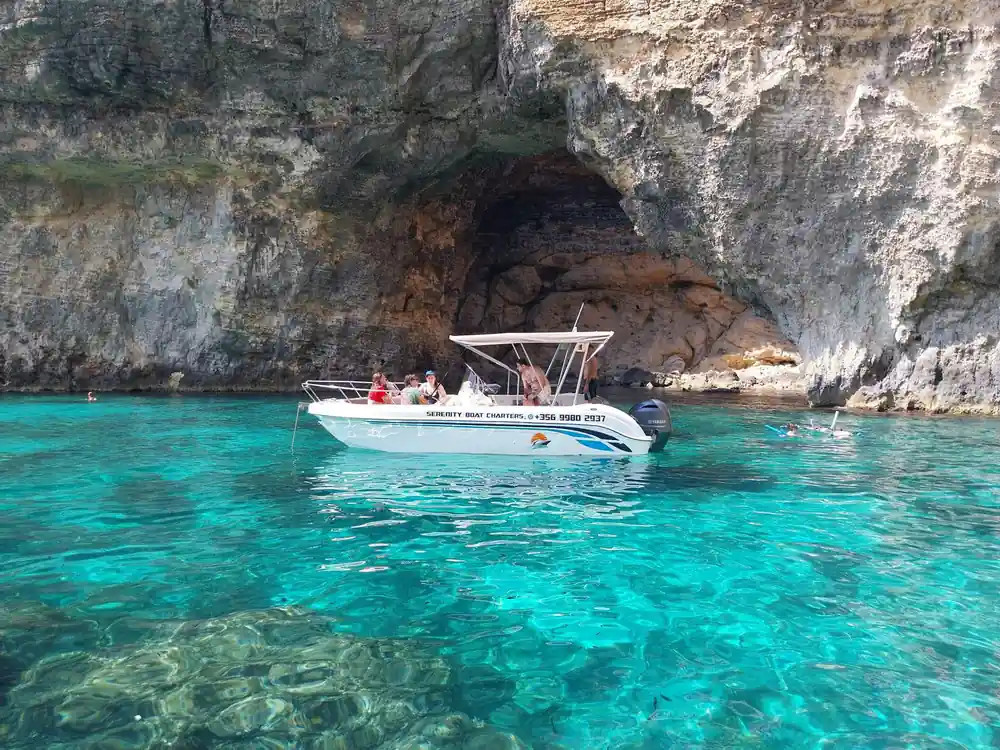
The cliffs of Comino fall straight into deep water, with cave mouths at sea level.
Which caves a boat can enter
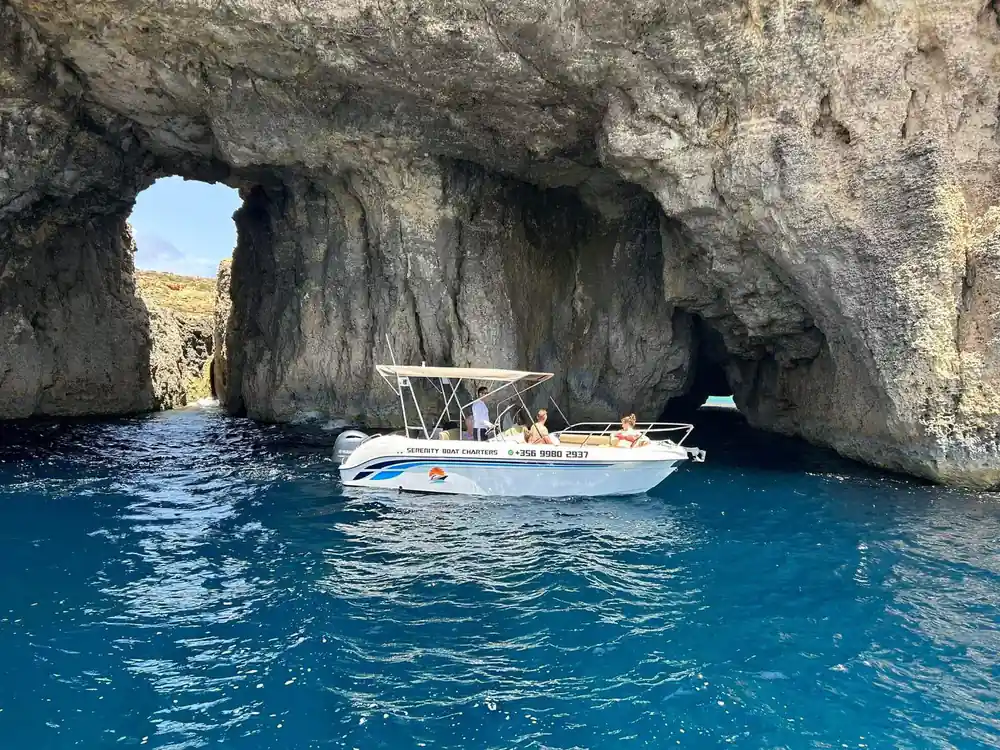
Not every cave is enterable. The width of the mouth, the height of the roof and the swell on the day decide it, and skippers judge each one from the wheel. Some are wide enough for a small boat to glide in and turn around, others are best looked at from outside with the engine idling. A small boat can usually go further in and wait longer than a large cruise vessel, which has to keep its distance and keep its schedule.
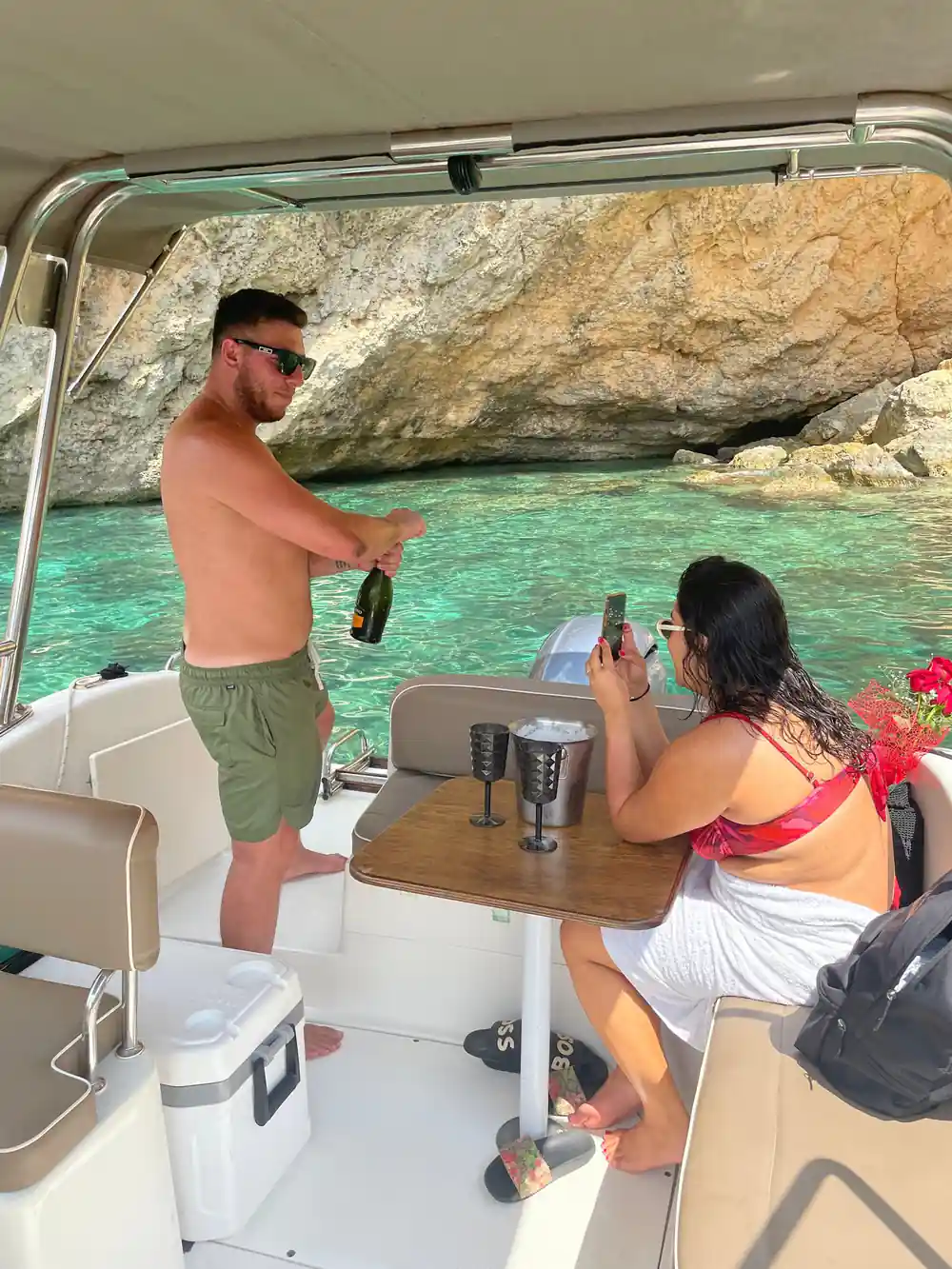
The private tour booked from this site is a good example of the small-boat approach. You travel as a private group with a live tour guide who speaks English, the boat skips the line through a separate entrance, and the trip runs 2 - 4 hours with swim stops.[4] With the boat to yourselves, the crew can hold position at a cave mouth while you take photographs, or move on when another boat arrives and the light changes.
Where the Comino sea caves are
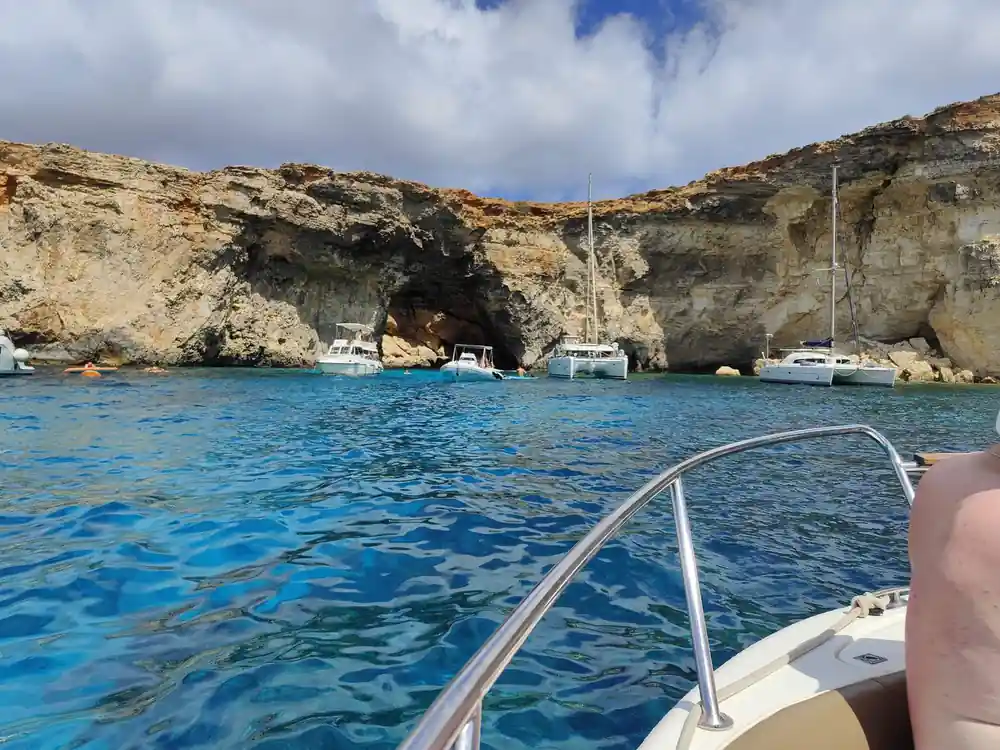
The cave group most trips visit is the Santa Maria Caves on Comino, one of the Maltese islands.[1] Boat routes usually string them together with the Blue Lagoon and Crystal Lagoon, plus a run along the Gozo coast and a look at the sea stacks in between. A route sold as a Blue Lagoon Malta caves trip usually takes in both the lagoon and the caves, with a swim stop somewhere in the middle of the day.
Getting there is straightforward. Ferries run from Mġarr on Gozo and Ċirkewwa on Malta to the Blue Lagoon, and the crossing takes approximately 15 minutes each way.[2] Above the water, Santa Marija Tower was built in the 17th century as a defensive structure and completed in 1618, during the reign of Grand Master Alof de Wignacourt.[10] The caves are a short ride from the lagoon, so most people see them as part of a boat trip rather than as an outing of their own.
from US$195
The private boat tour to the Blue Lagoon, Comino, Gozo and the sea caves with swim stops is rated 4.98 from 117 reviews.[4]
Swimming at the cave mouths
Swimming near the caves is not the same as swimming in the Blue Lagoon. There is no sandy shelf in front of the mouths, the water is deeper, and boat traffic passes close by. Go in from the boat with the engine off and the crew watching, stay inside the area they point out, and keep clear of the rock where the swell lifts you towards the roof. If the swell is up, watch from the deck instead and save the swimming for the lagoon.
Water temperature decides how long you stay in. In Sliema, average sea water temperature is warmest in August at about 26.1°C and coldest in February at about 15.4°C.[11] Air temperatures follow the same curve, with daily means in Malta ranging from 12.6°C in February to 27.5°C in August and an annual average of 19.5°C.[12] Malta gets almost 3000 hours of sunshine a year, and the surface warms quickly on a still morning.[13]
Photographing the caves and the lagoon
Light decides everything here. Good cave photographs come when the sun is high enough to bounce off the water inside the mouth but not so high that the roof turns black. Shoot from the shaded side of the boat, expose for the bright water, and let the rock fall into silhouette. A polarising filter cuts the glare on the surface and brings the colour below it back. Wipe your lens often, because spray dries into salt spots that show up on every frame.
Some crews call this stretch the blue caves Malta is known for, and on a bright day the name makes sense. The Blue Lagoon caves Malta visitors photograph most sit close to the lagoon, where the pale sand below makes the water glow. The Blue Lagoon has appeared as a film location in several big-screen productions, so parts of the view may already look familiar before you arrive.[14]
When to see the Comino caves
Summer is the obvious season and the busiest one. In peak summer, in July and August, the Blue Lagoon receives between 2,500 and 3,500 visitors per day.[15] The caves along the same cliffs stay quieter than the lagoon, and an early or late departure makes a real difference to how the mouths feel when you get there.
Shoulder seasons are gentler. The sea is usually swimmable, the light is softer, and there are fewer boats on the water. In 2024 Malta received roughly 3.6 million international tourists.[16] Winter trips depend on the weather and the swell, and the caves are at their calmest on settled days, when the water inside the mouths is clear enough to see the rock below.
Daily mean air temperature in Malta
Daily mean air temperature by month, based on 1991-2020 climate data for Valletta, Malta.[12]
What the boats to the caves cost
US dollar from prices for these GetYourGuide listings:[4][5][6][17]
When to book a caves trip
Plan your Comino caves trip
Pick your boat
Small private boats reach the cave mouths that big cruises only pass. Look for swim stops and sea caves in the listing, not just a lagoon drop-off.
Book ahead
Reserve now and pay later, with free cancellation up to 24 hours in advance for a full refund on the private tour.[4]
Check the start time
Departures vary, so check availability to see starting times before you fix the rest of your day.[4]
Pack light
Swimwear, a towel, sun cream, a hat and a dry bag for your phone. Grippy sandals help on a wet deck.
Go early
The first boats of the day get the calmest water and the clearest view into the cave mouths.
See the Comino sea caves from your own boat
from US$195Reserve now & pay later