The essentials
- The boat day links the Blue Lagoon, the Santa Maria Caves and Gozo's cliffs, with swim stops where the channel is calm.
- July and August are the busiest: between 2,500 and 3,500 visitors a day at the Blue Lagoon.[1]
- Private boat trips start from US$195, while shared cruises over the same water start from US$35 to US$40.[2][3][4]
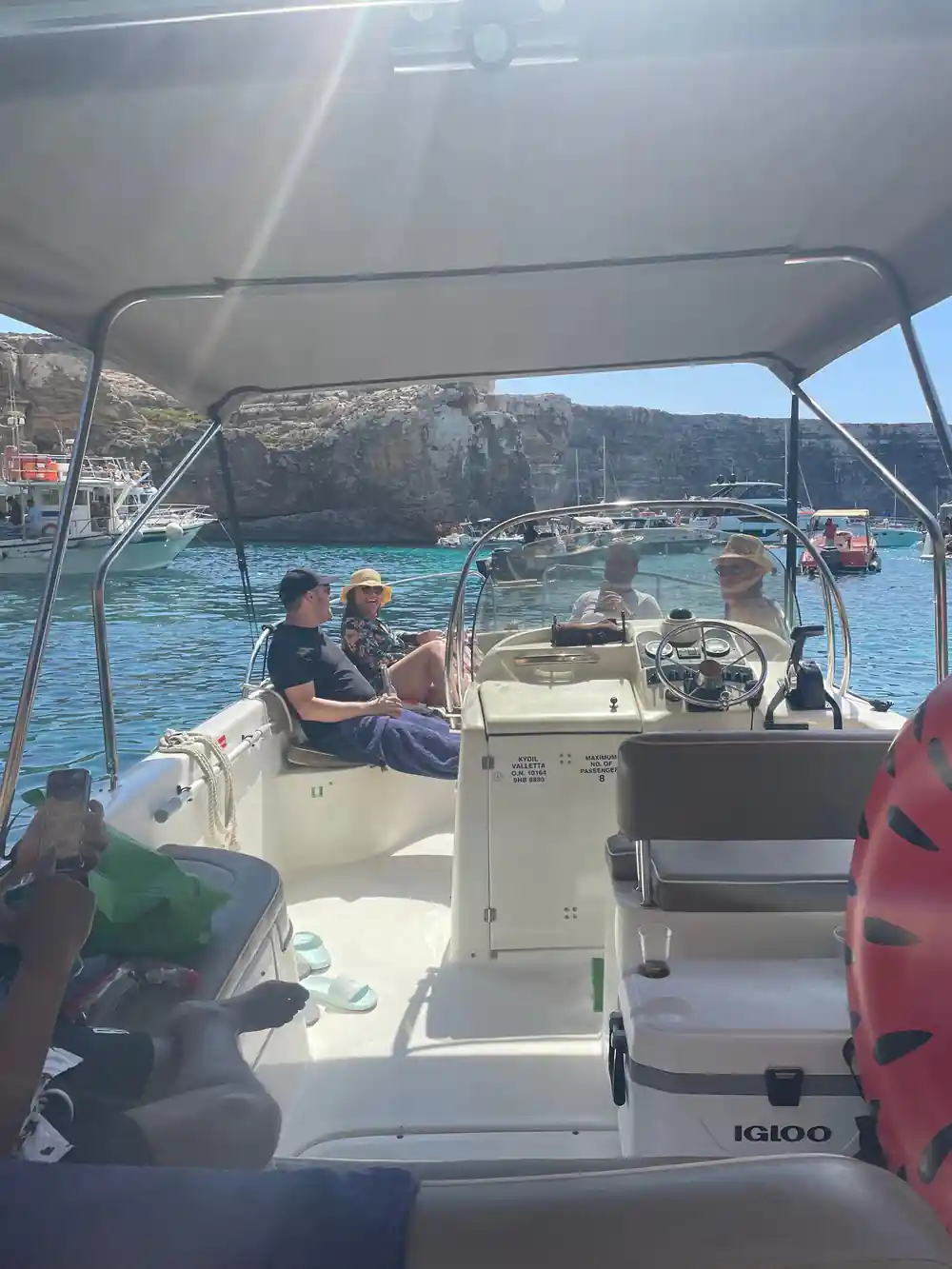
- Most cruises pass Gozo rather than land on it. The private tour from this site runs 2 - 4 hours with swim stops.[2]
- Gozo suits anyone who wants cliffs, caves and quiet water more than a harbour town and a fixed timetable.
- Top choice Private boat and swim stops from US$195 Duration2 - 4 hours[2]Rating4.98 from 117 reviews[2]GuideLive tour guide: English[2]CancellationFree cancellation up to 24 hours ahead[2] Check availability
- Catamaran beaches and bays from US$63 Duration5 - 6 hours[5]Rating4.68 from 6,838 reviews[5]GuideHost or greeter: English[5]CancellationFree cancellation up to 24 hours ahead[5] See this tour
- Comino and Crystal cruise from US$40 Duration5.5 - 7.5 hours[4]Rating4.53 from 7,774 reviews[4]GuideDriver: English[4]CancellationFree cancellation up to 24 hours ahead[4] See this tour
The jagged cliffs are home to the Yelkouan shearwaters (Puffinus Yelkouan, MT: Garnija). This seabird is a regional endemic, breeding only in the Mediterranean basin. Almost 10% of the total population nests on the Maltese Islands, with around 150-220 pairs estimated on Kemmuna.
Gozo from the water: our verdict
Booking tips
- Read the stop list: passing Gozo is not the same as landing on it
- Every price you see here is a from-price in US dollars
- Private groups suit families, couples and small parties
- Check the cancellation terms on your listing before you pay
On the water
- Sun cream, a hat and sunglasses: there is little shade on deck
- Bring a light layer for the ride and a towel for the swim stops
- Keep your booking confirmation on your phone for boarding
- Ask about boarding help in advance if anyone in your group needs it
Where Gozo sits in the Maltese archipelago
The Maltese islands lie in a line running north-west across the channel between Malta and Gozo, with Comino in the middle. Comino is tiny and almost empty: it has an official population of 4[6] and no village, just a tower, a chapel and a great deal of rock and water. Gozo rises beyond it, greener and slower, with terraced fields, fishing bays and the flat-topped hill of its Citadel above Victoria. From the deck of a boat you read the whole group in one sweep: low cliffs, a shallow bright channel, and small craft moving between the islands all day.
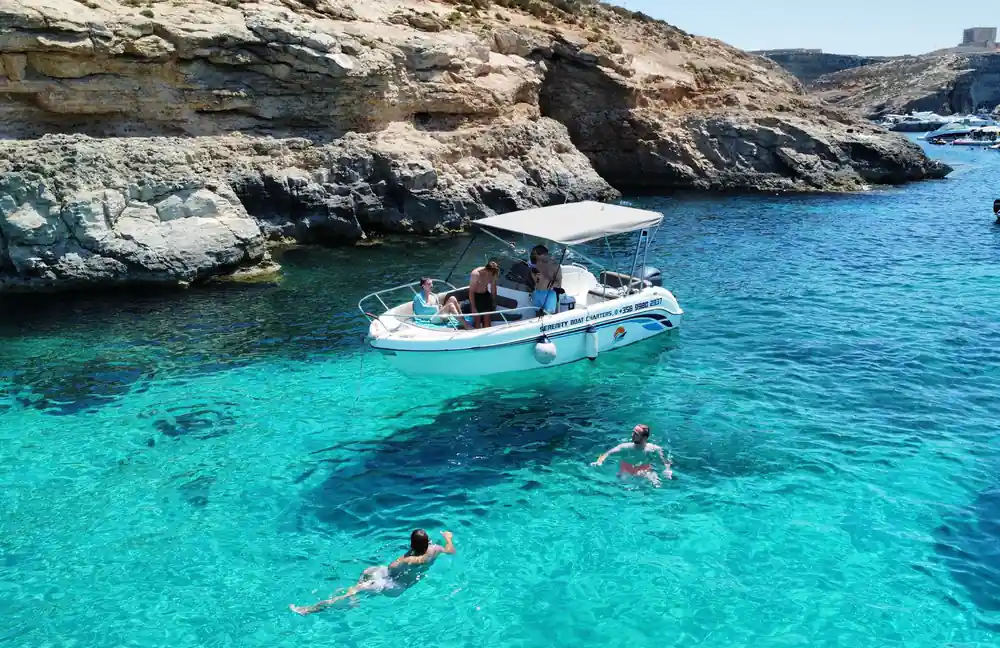
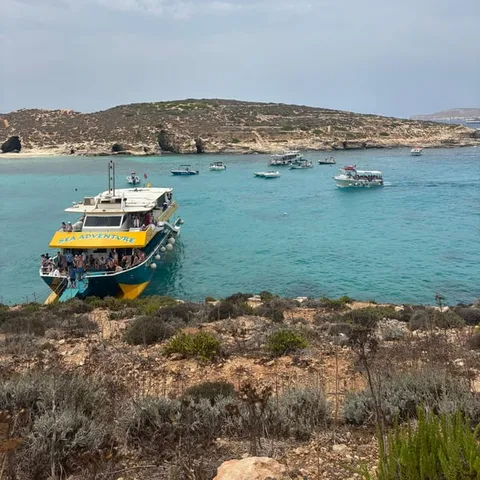
Most boat trips in this part of Malta follow the same water. They leave from the north of Malta or from Gozo, run along the Comino shore, stop at the Blue Lagoon or the Crystal Lagoon, and pass Gozo's cliffs on the way. The standard version is a Blue Lagoon Malta Gozo loop with the sea caves folded in, and it works because the channel between the islands is sheltered and calm enough to swim from the back of a boat.
A note on names before you book. Listing titles use Blue Lagoon, Comino, Gozo, Crystal Lagoon and sea caves almost interchangeably, and the differences between them matter more than the words suggest. Two trips with nearly identical descriptions can spend their hours in completely different places, so it is worth reading the stop list line by line rather than the headline.
What you actually see of Gozo from a boat
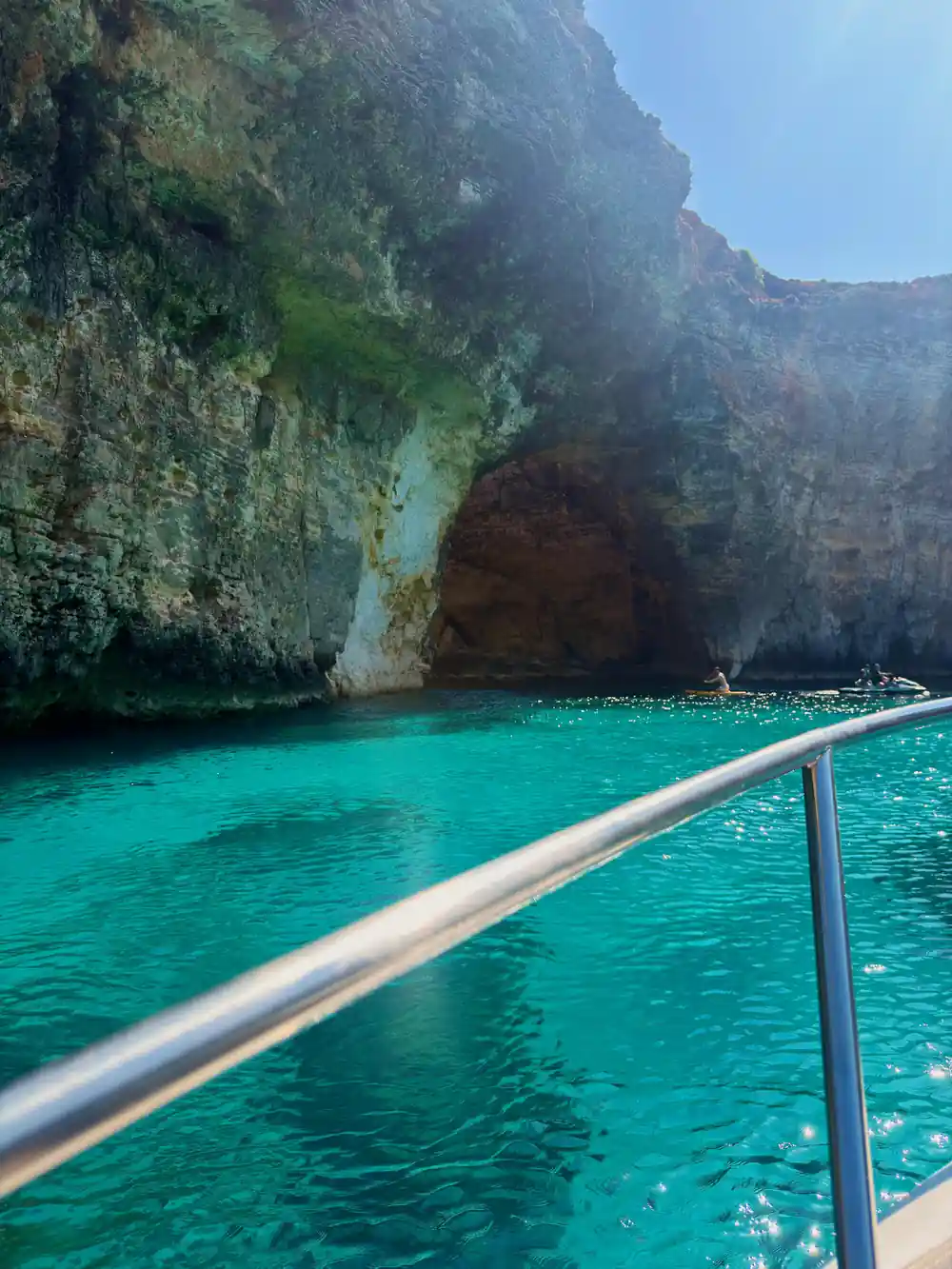
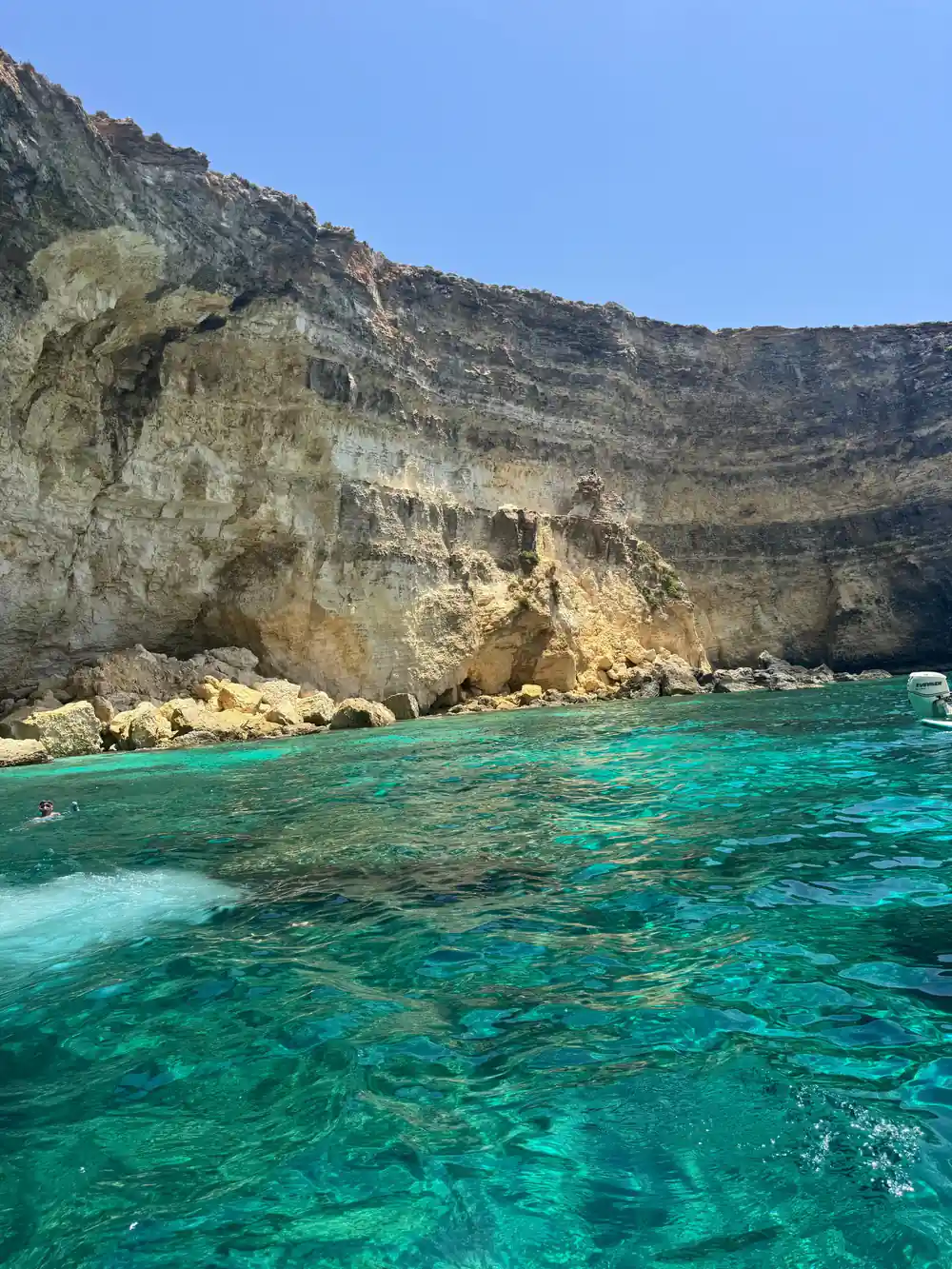
From sea level, Gozo is mostly cliff. The limestone has been worked by wind and waves into overhangs, caves and narrow inlets, and the water below shifts from pale turquoise over sand to deep navy within a few strokes. The cliffs are also a breeding ground: the Yelkouan shearwater nests on Kemmuna, with an estimated 150-220 pairs on the island, and the birds are most active around dawn and dusk when they move between the sea and their burrows.[7]
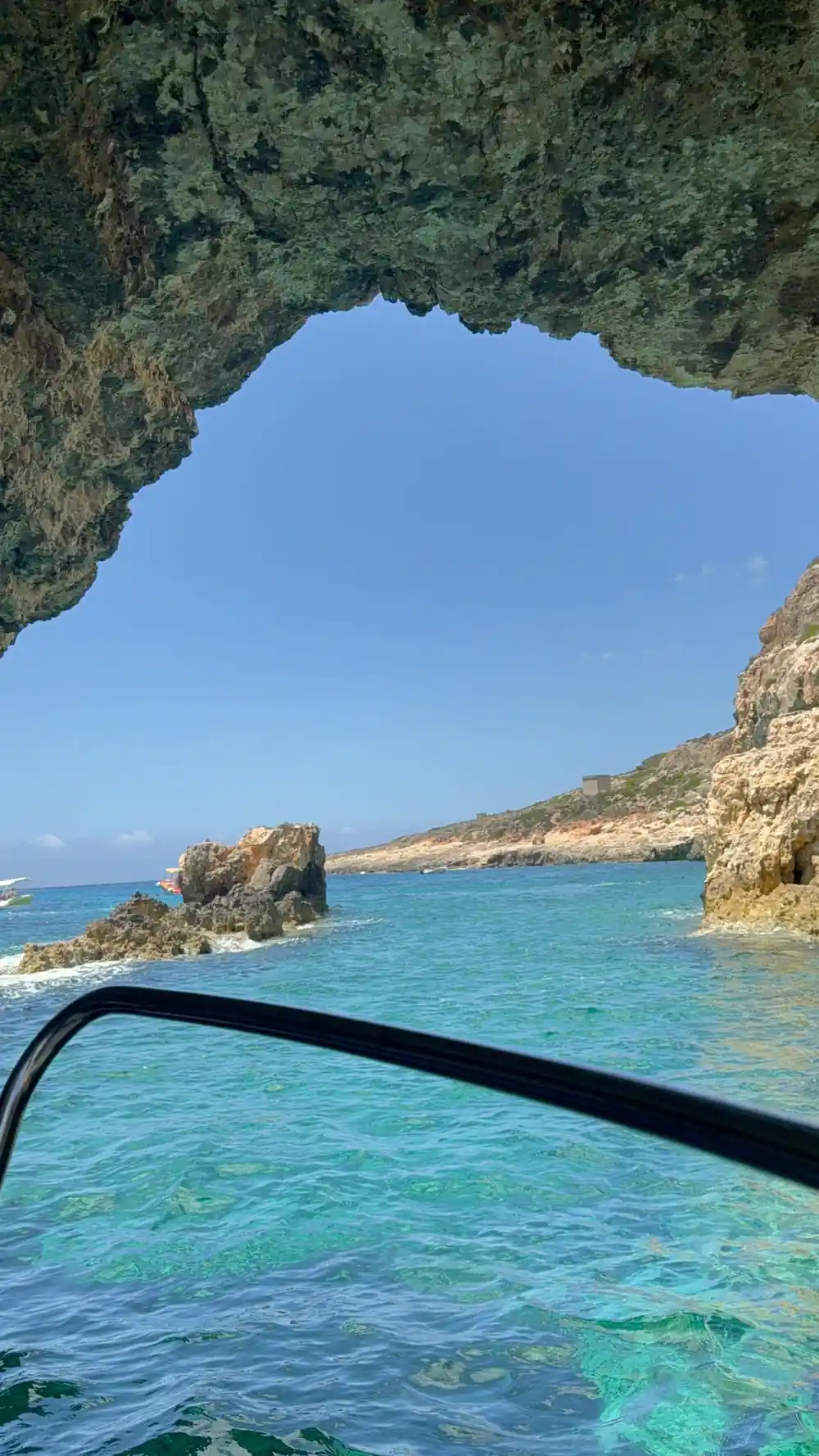
The other constant is caves. The Santa Maria Caves on Comino consist of five caves, and boats nose into them one at a time so passengers can watch the light come back off the walls.[8] Between them are flat shelves of rock where people swim, and on the Gozo side you pass the salt pans at Xwejni, the little bays at Xlendi and Marsalforn, and the watchtowers that stand on the headlands.
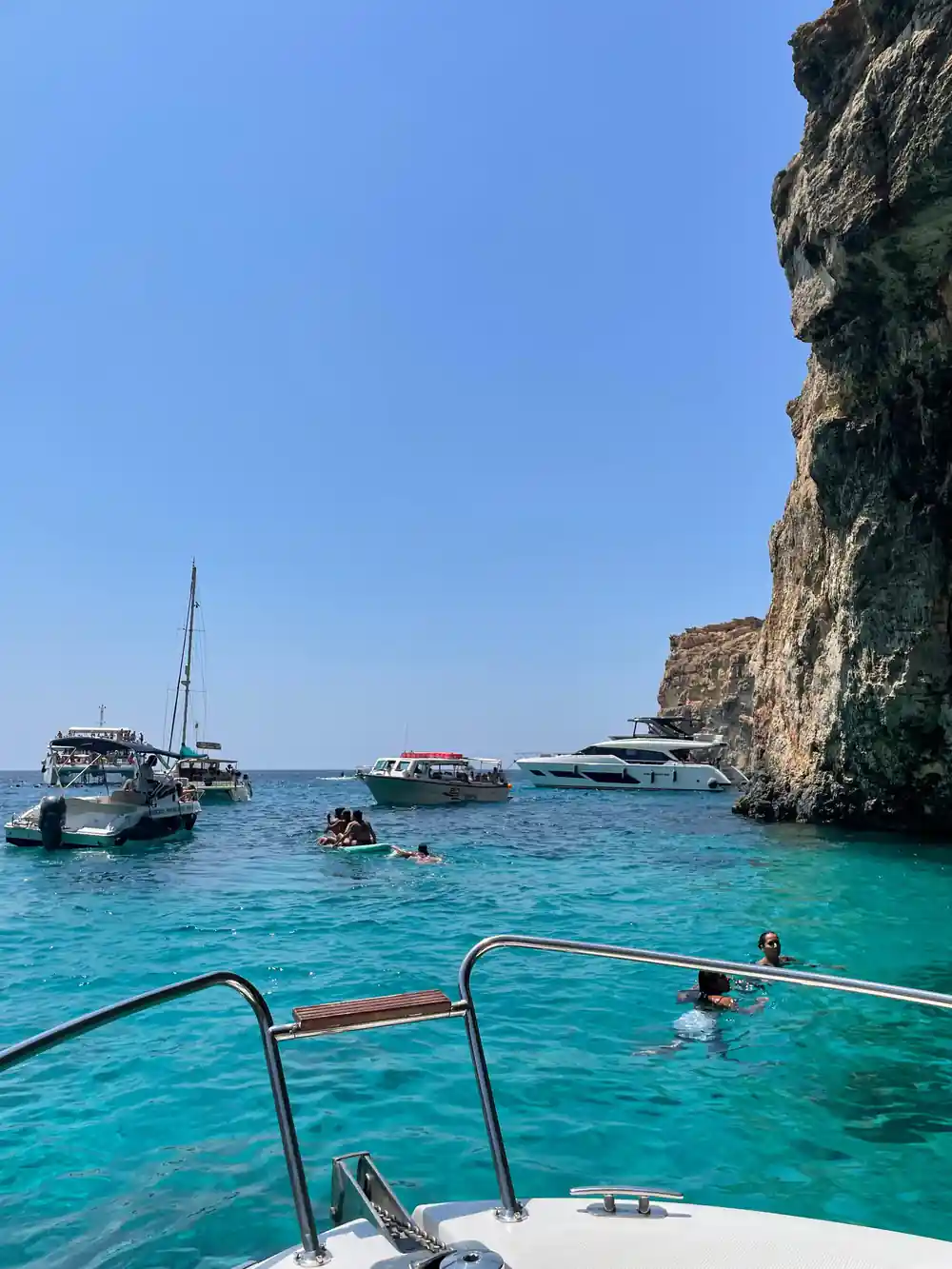
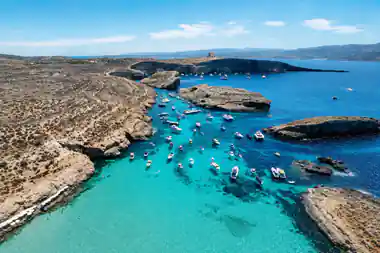
The Blue Lagoon is the colour everyone photographs, and it is worth knowing why it looks like that. The turquoise comes from light reflecting back up through shallow, clear water from the white sand below.[9] The bay has appeared in several big-screen productions; the view may already seem familiar the first time you round the headland.[10]
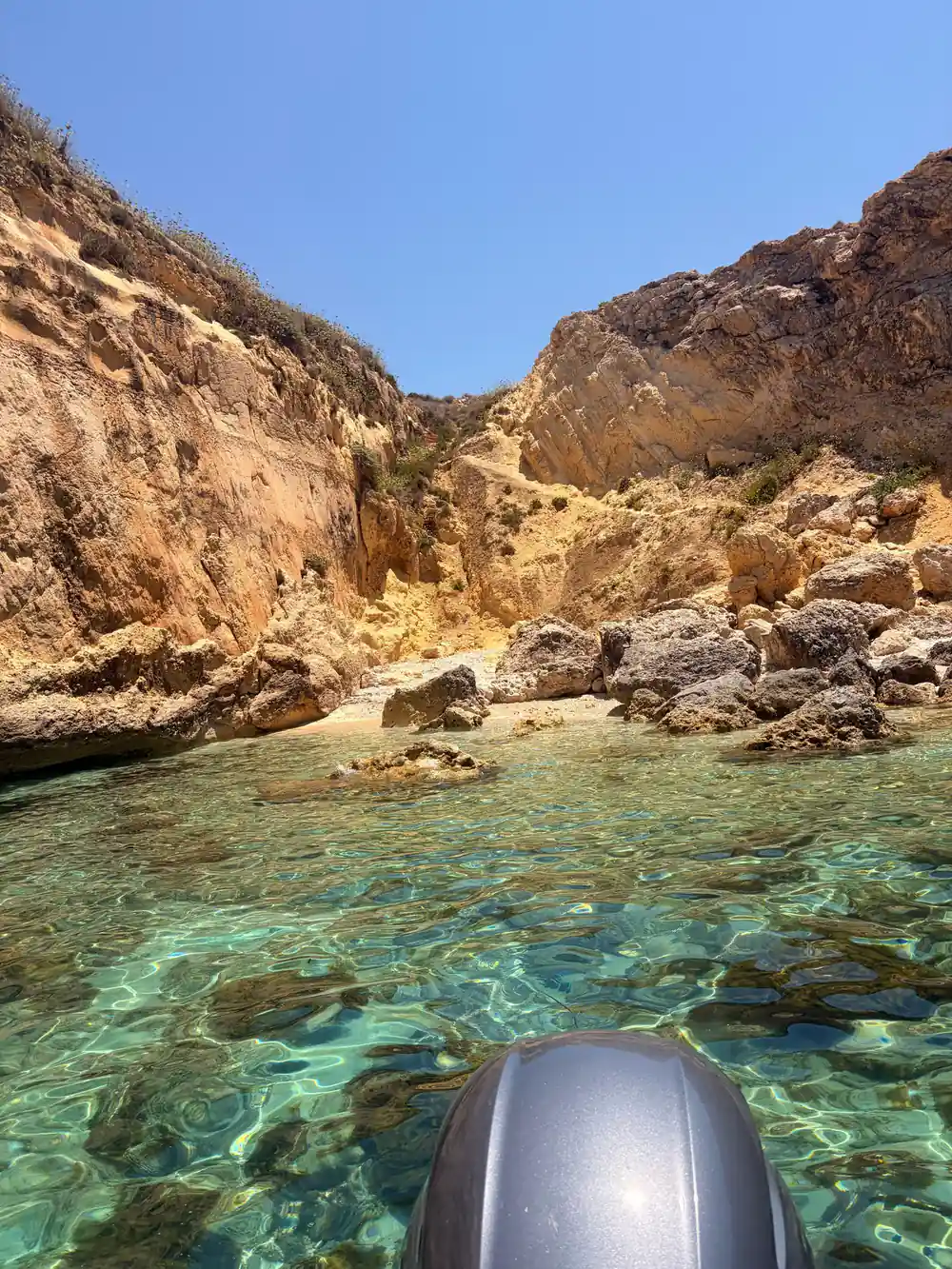
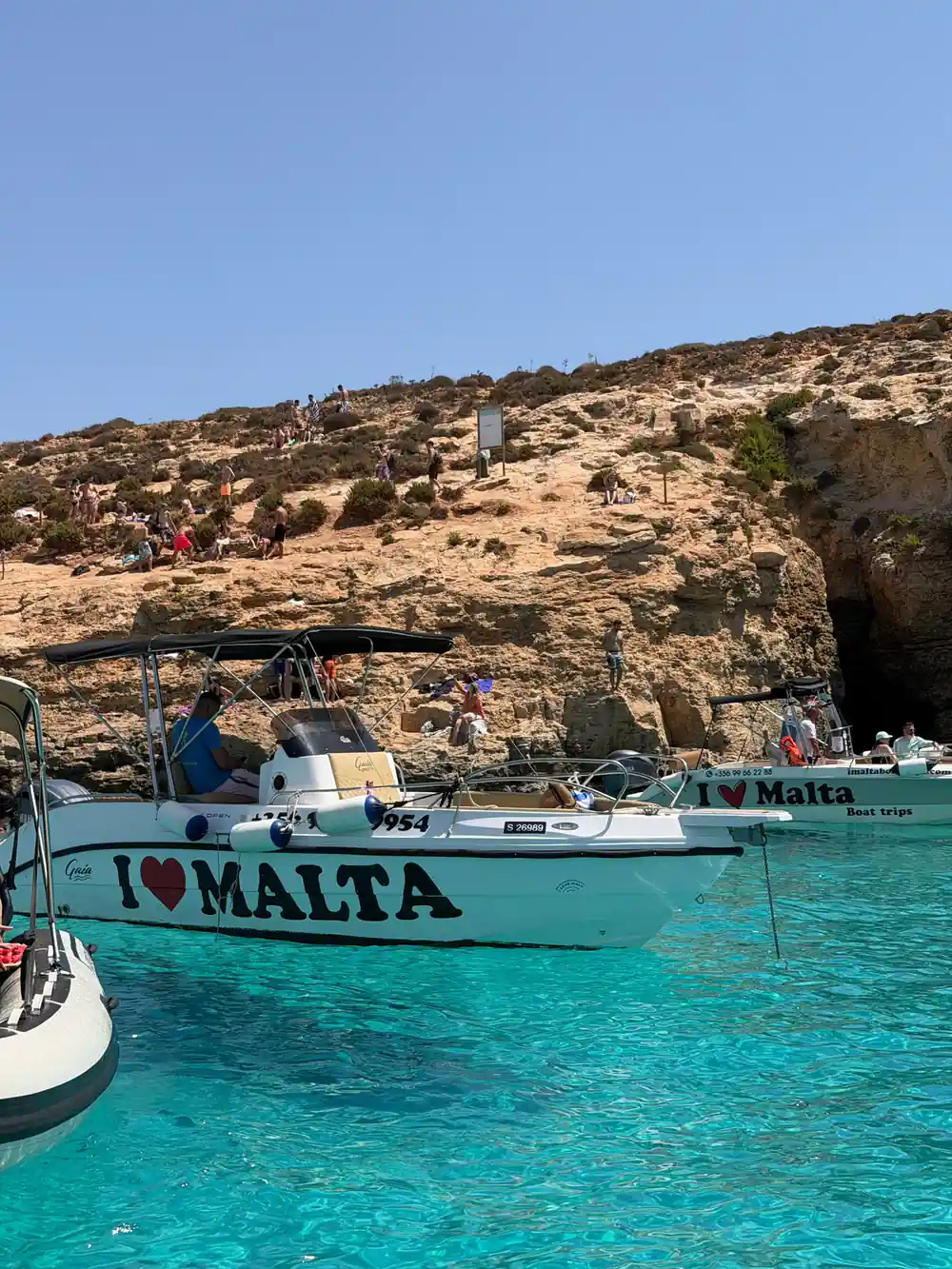
Cliffs, caves and calm water in the channel between Comino and Gozo.
The Azure Window, and what is there now
The Azure Window was the arch of limestone that stood on Gozo's west coast at Dwejra and gave the place its fame. The arch itself has fallen; the name has stayed on the maps and in the commentary on every boat that passes. What remains is the flat shelf of rock where it met the sea, deep blue water beside it, and the Inland Sea, a narrow channel that runs inland from the coast to a small enclosed pool. The coastline on the way there is the wildest on either island.
What people do at Dwejra now is swim, snorkel and photograph the colours. The Inland Sea is the calm, sheltered option, and the Blue Hole is the divers' site beside it. If you want to dive blue waters Gozo keeps a few of them here, where the rock drops away close to the shore. On the surface it can look flat and easy, so go with a boat or guide that knows the site and stay with the group.
One practical point: not every trip goes round to Dwejra. It sits on the far side of Gozo, and the further west a route goes, the more of your booked hours are spent travelling. Read the stops on the listing before you decide, and ask the operator whether Dwejra is part of the plan or only a name on the map.
Mġarr harbour from the water
Mġarr is Gozo's front door: a wide bay with the ferry ramp at the back, a church on the rise behind it, and a waterfront of small fishing boats, luzzu with painted eyes on the bow, and restaurants that fill at lunchtime. From a boat idling just outside, you take in the whole shape of the harbour in a few minutes.
It is also the busiest stretch of Gozo's coast. Ferries come and go, dive boats load up, and yachts moor along the quay. If your trip includes a stop here, watch the time: Mġarr is a coffee and a short walk up to the church rather than a full afternoon ashore.
From the harbour mouth the channel opens north towards Comino, and the tower on the Comino shore is usually pointed out from the deck. Santa Marija Tower is a defensive structure built in the 17th century as part of the Knights of St. John's fortification efforts, and it was completed in 1618 during the reign of Grand Master Alof de Wignacourt.[11]
from US$195
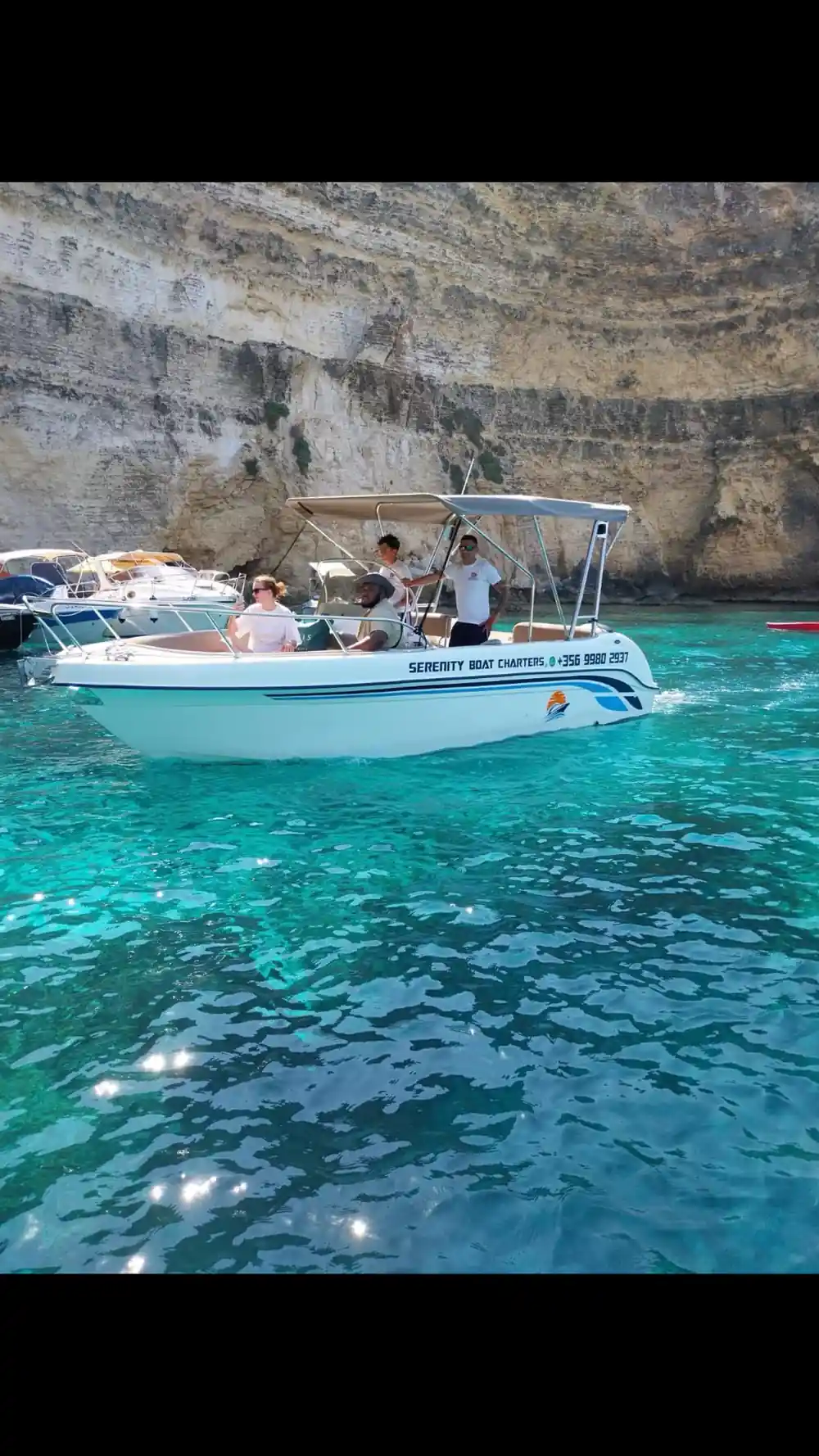
The private boat tour booked from this site, with swim stops between the Blue Lagoon, Comino, Gozo and the sea caves.[2]
Is landing on Gozo realistic on a boat trip?
Sometimes, but not usually. Many trips along this coast pass Gozo, slow down for the cliffs and the caves, and carry on to the lagoons. The private boat tour booked from this site runs 2 - 4 hours with swim stops.[2] If a listing promises Gozo, check whether it means a landing at Mġarr or a view from the sea.
If walking on Gozo matters to you, plan it as its own day. Ferries cross to Mġarr from Malta's northern coast, and on the island the City Sightseeing hop-on hop-off bus starts from US$25 and is valid for 1 day from first activation.[12] A guided island day trip with the Ġgantija temples and lunch starts from US$92 and lasts 9 hours.[13]
The pleasant version of all this is two days: one on the water around Comino and the Blue Lagoon, one on Gozo by land. Ebsons runs a pick up and drop off ferry service from Mġarr on Gozo and Ċirkewwa on Malta to the Blue Lagoon, Comino every hour, and the crossing takes approximately 15 minutes each way.[14] That makes the two islands easy to combine without a car.
How Gozo differs from Malta
Malta is busy and built up, and the visitor numbers show it: in 2024 the country received roughly 3.6 million international tourists.[15] Gozo and Comino feel different, with much of them protected, empty or both. Comino is a bird sanctuary and nature reserve, a Natura 2000 marine protected area,[16] so its cliffs and coves are left to the birds and the boats rather than to development.
The climate is shared across the islands and it is the reason boats can run for so much of the year. Malta gets almost 3000 hours of sunshine a year and is the sunniest country in Europe.[17] In Sliema the average sea water temperature is warmest in August at about 26.1°C and coldest in February at about 15.4°C.[18] Daily mean air temperatures in Valletta range from 12.6°C in February to 27.5°C in August, with an annual average of 19.5°C.[19]
Ashore, Gozo is villages, vineyard slopes, a Citadel you can walk up to, and a food scene that has grown around the wine. To combine it with the sea, a wine tasting and paired dinner on the island starts from US$106,[20] and a cooking class with a market visit starts from US$85.[21] Neither needs a boat, which makes them easy to slot in beside a day on the water.
Whether to add Gozo to your Blue Lagoon day
For most travellers the answer is yes, but as a view rather than a stop. Gozo's cliffs are the best scenery on the route and they cost nothing extra, since the boats pass them between the lagoons and the caves. The private boat tour booked from this site takes 2 - 4 hours and starts from US$195, with a private group, a live guide in English, wheelchair access, skip the line through a separate entrance, reserve now and pay later, and free cancellation up to 24 hours in advance.[2]
If you would rather share the boat and the cost, there are cheaper ways to see the same water. A catamaran trip covering the Blue Lagoon, beaches and bays starts from US$63 and runs 5 - 6 hours.[5] A cruise from Sliema to the Blue Lagoon, Crystal Lagoon and the sea caves starts from US$40 and runs 5.5 - 7.5 hours.[4] The Gozo and Comino islands tour with the Blue Lagoon and sea caves starts from US$35 and runs 7 hours.[3]
Timing matters more than the boat. In peak summer, July and August, the Blue Lagoon receives between 2,500 and 3,500 visitors per day.[1] The Gozo Blue Lagoon run is the standard route here, so an early departure or a date outside high summer changes the feel of the day more than any upgrade on board. Book ahead for peak summer dates and keep your morning free.
Daily mean air temperature in Valletta
Daily mean air temperatures for Valletta, Malta, based on 1991-2020 climate data.[19]
What a boat day to Gozo and Comino costs
When to book a Gozo and Blue Lagoon boat day
Planning the Gozo day
Decide what Gozo means to you
A pass along the cliffs, a swim stop in the channel and a few hours ashore at Mġarr are three very different days.
Pick the boat that matches
Private charters, catamarans and shared cruises cover the same water at very different prices.[2][5]
Book the early departure
Early boats reach the lagoon before the crowd; in July and August it can take 2,500 to 3,500 visitors a day.[1]
Pack for sun and water
Swimwear, a towel, a hat and sun cream. Malta gets almost 3000 hours of sunshine a year.[17]
Keep a plan B ready
Wind can change a route, so keep a land day in reserve and note the free cancellation terms.[2]
Ready to see Gozo and Comino from the water?
from US$195Reserve now & pay later